
Why does a dining table wobble, and how do you pick one that stays rock-solid? A practical guide to bases, joins, floors and showroom checks before you buy.

It is one of the most common complaints you will see on furniture forums: "We bought a new dining table and it already wobbles. Is that normal, and what should we have looked for?" People describe tables that rock every time someone leans on an elbow, glasses that shiver when a child kicks a leg, and bolts that need tightening every few weeks. Some blame the floor, some blame the brand, and most wish they had known what to check before handing over the money.
The good news is that a wobbly dining table is rarely bad luck. It usually comes down to a handful of things you can see and test in a showroom in a couple of minutes. Here is what actually makes a dining table stable, and how to choose one that will still feel solid years from now.
Why dining tables wobble in the first place
There are really only three causes of a wobble, and it helps to know which one you are dealing with.
The base flexes. If the legs or frame bend slightly under side-to-side pressure, the whole top moves with them. This is a design and materials issue: thin legs, long unsupported spans and weak joints all add up.
The joints loosen. Many tables are held together with bolts into wood or metal brackets. If those joints are small or rely on a single bolt per leg, everyday use slowly works them loose. Timber also shrinks and swells with Melbourne's dry summers and damp winters, which can open up joints over time.
The floor is uneven. Older homes, floating floors and tiled areas are rarely perfectly level. A four-legged table will always rest on three legs if the floor dips, which feels like a wobble even when the table itself is perfectly built.
Telling these apart matters. A table that rocks diagonally but feels rigid when you push it sideways is probably a floor problem, which is easy to fix. A table that sways when you push the top sideways has a structural problem that adjustable feet will not solve.
Choose the right base for stability
The style of base has a bigger effect on stability than almost anything else.
Four legs with an apron: The classic design, where a frame (the apron) runs under the tabletop connecting all four legs. A deep apron with solid corner blocks is very stable. A shallow apron, or legs bolted straight onto the underside of the top with no frame, is where most wobbles start.
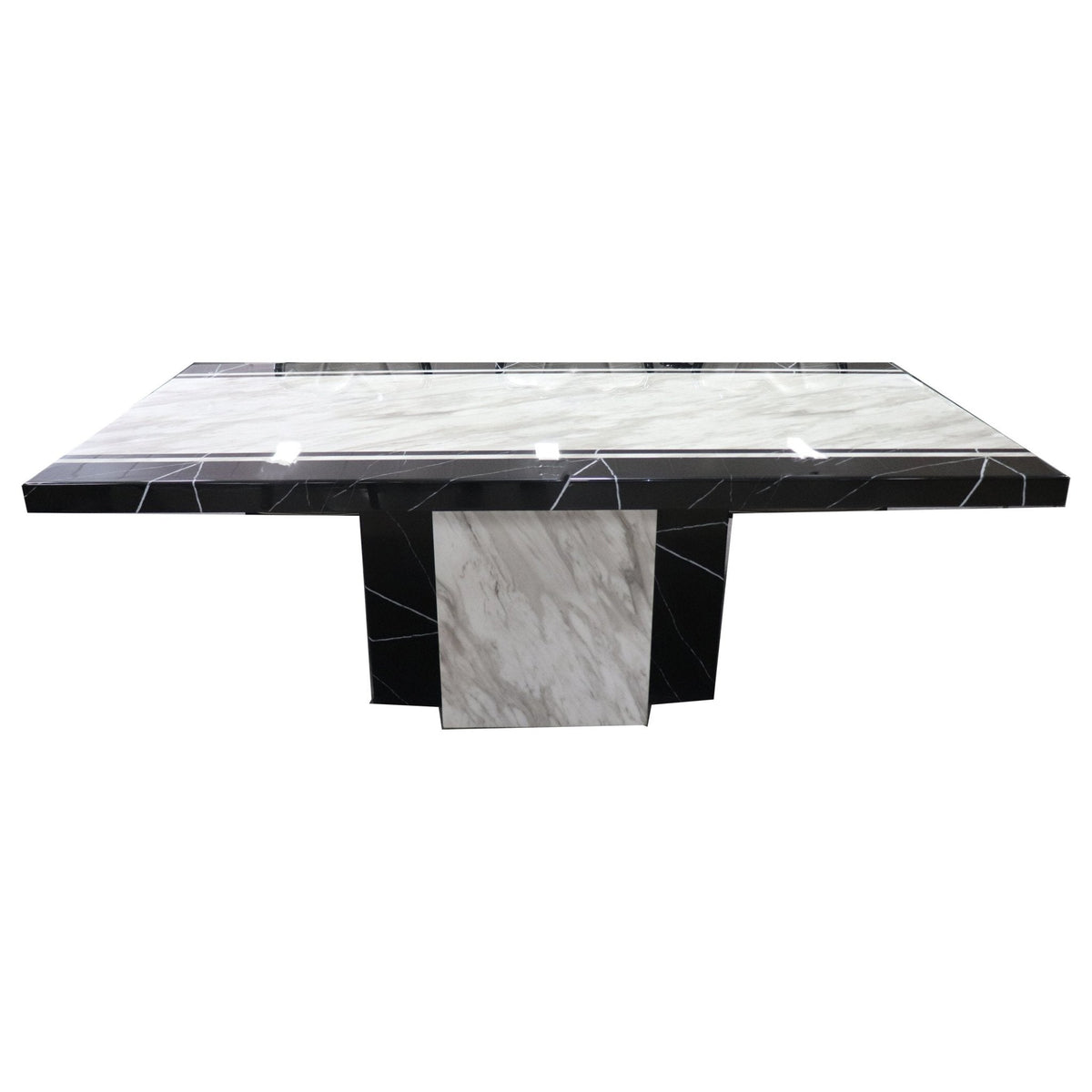
Pedestal and solid block bases: A heavy central or twin base, like a stone or marble pedestal, has no legs to rack sideways. Stability comes from weight and footprint. The key check is that the base is wide enough relative to the top. As a rough guide, the base should span a good portion of the table's length so that leaning on one end does not lift the other.
Sled, trestle and sculptural metal bases: Welded stainless steel bases in "U", "X" or interlocking shapes are popular in modern dining tables for good reason. Because the base is welded rather than bolted at every join, there is very little that can loosen. Look for a thick-gauge frame and a wide, flat foot that sits evenly on the floor.
If wobble is your biggest worry, a welded metal base or a solid stone base is generally the safest choice, especially for a busy family table.
The weight of the top matters, in both directions
A heavier top, such as marble, sintered stone or thick tempered glass, lowers the centre of gravity and makes a table feel planted. The trade-off is that the base has to be built to carry it. A heavy top on a light base can feel top-heavy and amplify any movement.
Ask how the top attaches to the base. Stone tops usually sit on rubber or silicone pads and are held in place by their own weight plus fixings, which is normal. What you want to avoid is a top that shifts or clicks when you press down on a corner. Also confirm the overall weight before you buy if you live in an upstairs apartment or need to carry it up stairs.
A two-minute wobble test for the showroom
This is the part most people skip, and it is the part that saves the most regret. Before you buy any dining table, try the following:
Push the top sideways. Place both hands flat on one long edge and push gently but firmly along the length of the table, then across it. A good table barely moves. If the top sways and springs back, the base is flexing.
Lean on a corner. Press down on each corner in turn as if you were leaning an elbow on it. Watch the opposite corner. It should not lift.
Look underneath. Check how the legs or base attach. Are there several bolts per join, solid brackets or welds? Or one bolt into a thin piece of timber or particleboard?
Check the feet. Adjustable levelling feet are a big bonus, particularly for older Melbourne homes with uneven floors. Felt or rubber pads help on timber and tiles.
Sit at it. Pull up a chair, rest your forearms on the edge and shift your weight. That is the real-world test, and it takes ten seconds.
Fixing a wobble you already have
If your current table rocks, start with the easy fixes before blaming the table. Move it a little and see whether the wobble changes; if it does, the floor is the cause and a levelling foot or a discreet furniture shim will solve it. Next, tighten every bolt underneath with the right-sized tool, but do not overtighten into timber. If the table still sways sideways after that, adding corner brackets can help a wooden table, but a base that flexes by design will never be fully stable. At that point, a replacement is often the better long-term spend.
Find a solid dining table in Dandenong
Because stability is something you really need to feel for yourself, it is worth seeing a dining table in person before you commit. At Quality Rugs and Furniture in Dandenong, our range leans heavily towards welded stainless steel and solid stone bases paired with marble, sintered stone and tempered glass tops, which are exactly the designs that hold up to daily family use.
The Newcastle dining table pictured above uses a solid marble base for a planted, no-wobble feel, while the Sierra marble top dining table sits on a welded stainless steel base in a brushed gold finish. Drop into our Dandenong showroom, give them the push-and-lean test, and our team can talk you through sizes and delivery across Melbourne. You can also browse our full range of dining tables online first to make a shortlist.