
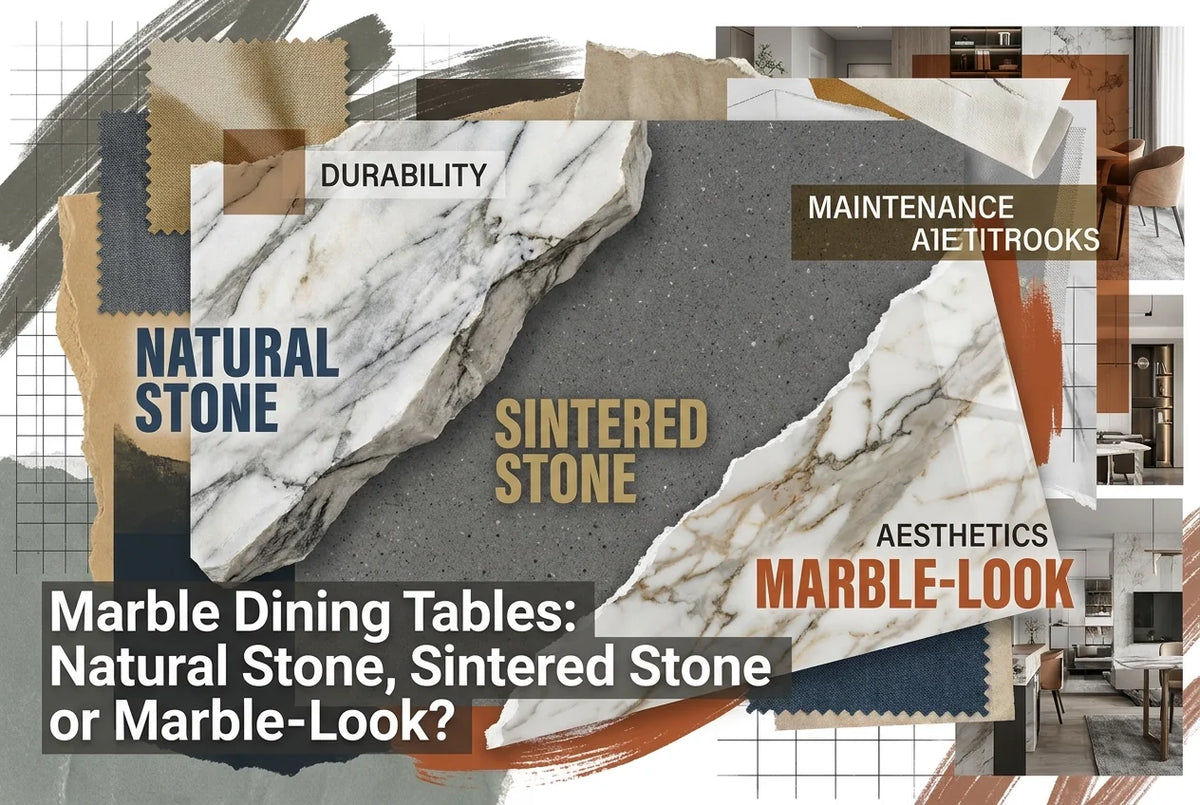
There's something undeniably beautiful about a marble dining table. That smooth, cool surface with its swirling veins and luxurious finish has a way of making any dining room feel instantly more elegant. It's no wonder so many homeowners have it at the top of their wish lists.
But here's where things get a little tricky. Walk into any furniture store today and you'll quickly discover that not all marble dining tables are created equal. Some are crafted from natural stone, others from something called sintered stone, and others are simply designed to look like marble without actually being marble at all. So how do you know which one is right for you?
If you're feeling a little overwhelmed by the options, don't worry. You're definitely not alone. In this post, we're going to break down the key differences between natural marble, sintered stone, and marble-look alternatives in a simple, easy-to-follow way. By the end, you'll have a clear picture of what each option offers, including the pros, the cons, and which type might be the perfect fit for your home and lifestyle.
The Three Types of Marble Dining Tables Explained
If you've ever searched "marble dining table" online and felt confused by the sheer variety of options, you're not alone. The term gets applied to three very different materials, and understanding what separates them is the most important thing you can do before spending a single dollar.
Natural Marble: The Real Deal
Natural marble is quarried directly from the earth. It's a metamorphic stone formed over millions of years, and every slab is genuinely one of a kind. The most prized sources include Carrara in Italy, known for its soft white background and delicate grey veining, and Emperador in Spain, which leans toward rich browns and dramatic patterns. That visual depth and luxury feel simply cannot be replicated perfectly by any manufactured material. However, natural marble comes with real responsibilities. Because it's composed of calcium carbonate, it reacts chemically with everyday acids like lemon juice, red wine, tomato sauce, and coffee, creating dull surface spots called etching. Sealing helps slow staining, but it does not stop etching. You'll also need to reseal the surface roughly twice per year to maintain protection. On top of that, natural marble tops are seriously heavy, typically weighing between 90 and 180 kg, which has significant implications for delivery logistics and the load-bearing capacity of your floor. For a deeper breakdown of what that weight really means at home, this marble dining table buyer's guide puts it plainly: a marble slab can weigh more than your refrigerator.
Sintered Stone: The Practical Middle Ground
Sintered stone, sometimes listed as porcelain stone or ultra-compact surface, is an engineered material created by compressing and firing minerals under extreme heat and pressure. The result mimics marble veining convincingly while delivering far superior resistance to acids, scratches, and heat. It won't etch when you spill wine on it, and daily cleaning requires no special products. Sintered stone tops also weigh considerably less, generally in the 40 to 80 kg range, making delivery and installation much more manageable. This comparison of sintered stone versus marble dining tables highlights why this material has become the go-to choice for families and everyday dining setups in 2025 and 2026.
Marble-Look Laminate: Budget Aesthetic, Lower Durability
The third category uses a printed or wrapped surface layer applied over an MDF or particleboard core. These tables achieve the marble look at the most accessible price points, but they sit at the bottom of the durability scale. The surface is vulnerable to chipping, peeling, and moisture damage over time, and there's no possibility of refinishing or restoration. Laminate tops are the lightest of the three options, which makes shipping easier, but that lightness also reflects the materials inside.
Why the Label "Marble Dining Table" Can Be Misleading
Here's the catch: retailers and online listings routinely use the phrase "marble dining table" across all three of these categories. Product photography can make natural stone, sintered stone, and laminate surfaces look nearly identical on screen. Before purchasing, always confirm the actual substrate material with the retailer directly. Asking one simple question, "Is this natural marble, sintered stone, or a laminate surface?" will save you from mismatched expectations and a disappointing delivery day.
Natural Marble vs. Sintered Stone vs. Marble-Look: Full Comparison
Now that you know what each material actually is, let's put them head to head across the five things that matter most when buying a marble dining table: durability, maintenance, aesthetics, weight, and price. This side-by-side breakdown will help you figure out which option genuinely suits your home, without any guesswork.
Durability: How Each Material Holds Up at the Dinner Table
Natural marble looks stunning, but it has a real weakness that catches a lot of first-time buyers off guard. The stone is made largely of calcium carbonate, which reacts chemically with everyday acidic foods and drinks. Lemon juice, tomato sauce, red wine, vinaigrette, and even coffee can etch the surface permanently, leaving dull, discoloured patches that no amount of scrubbing will fix. Getting those spots out requires professional resurfacing, which adds cost and hassle you probably didn't budget for. Sintered stone is the clear winner here. It's manufactured by compressing and firing natural minerals at extremely high temperatures, producing a surface that is scratch-resistant, stain-resistant, and completely unbothered by acids. According to this detailed comparison of sintered stone vs marble dining tables, sintered stone also handles heat well, so hot serving dishes placed directly on the table aren't a concern. Marble-look laminate sits in the middle; it won't etch like natural marble, but the surface coating can chip at edges over time, and moisture that gets into seams can cause swelling.
Maintenance: What You'll Be Doing Every Week and Every Year
If you choose natural marble, sealing becomes part of your regular routine. You'll need to reseal the surface roughly twice a year to slow down staining, and even then, sealing doesn't prevent etching from acids. Spills need to be wiped up immediately, not left for a few minutes while you finish your meal. Sintered stone requires almost none of that. It's non-porous, so there's nothing to seal, and cleaning is as simple as wiping it down with a damp cloth or mild household cleaner. For busy households, especially those with young kids or a dining table that doubles as a homework desk or workspace, this is a genuinely significant difference. Marble-look laminate is similarly low effort and needs only standard surface cleaning, making both alternatives far more practical for everyday use.
Aesthetics: Looks Aren't Everything, But They Matter
Here's where natural marble still holds its ground. Each slab is geologically unique, with veining patterns and a natural translucency that no manufactured product has fully replicated. There is a warmth and depth to real marble that you can see and feel, which is a big part of why it carries such strong aspirational appeal. Sintered stone has genuinely closed the gap, though. Advances in high-resolution surface printing and edge profiling mean that a quality sintered stone top can look remarkably close to the real thing, especially in everyday lighting. Under bright, direct light, a more discerning eye might notice that sintered stone can appear slightly flatter compared to marble's natural depth, but for most households, the difference is minor. Marble-look laminate is the most budget-oriented option aesthetically; the pattern is printed rather than structural, and edge cuts can reveal the substrate underneath, which makes it look less convincing up close.
Weight and Logistics: Getting It Into Your Home
This one surprises a lot of buyers. A natural marble dining table top can weigh anywhere from 90 to 180 kg, which means the base needs to be reinforced to carry that load safely. Delivery typically requires a two-person team, a clear path with hard flooring, and sometimes prior planning if you live in an apartment or upper-floor property. Moving or repositioning it later isn't a casual job. Sintered stone tops are substantially lighter because the material is typically thinner and often applied over a lighter substrate, making delivery and placement much more straightforward. Marble-look laminate is the lightest of the three and presents no real logistics challenges at all.
Price: What Each Tier Will Cost You in Australia
Budget plays a major role in this decision, and the price differences between the three tiers are significant. Marble-look laminate is the most accessible entry point, generally ranging from around $400 to $900. Sintered stone sits in the mid-to-premium range, typically between $900 and $2,200. Natural marble starts at roughly $1,800 and can climb well past $5,000 depending on the slab origin, with Italian varieties like Carrara and Calacatta commanding higher prices than Asian-quarried stone. The base material, size, and any customisation will also push the price up.
Across all five axes, the right choice really comes down to your household, your budget, and how much upkeep you're willing to commit to. A household with young children and daily casual dining has very different needs from a formal dining room used mainly for entertaining.
Who Should (and Should Not) Buy a Natural Marble Dining Table
So you've weighed up the materials and you're leaning toward genuine marble. Before you commit, it's worth being honest with yourself about how your household actually lives, because natural marble rewards the right buyer and frustrates everyone else.
Natural Marble Is a Great Fit If...
Natural marble genuinely shines in a dedicated formal dining room, the kind of space that gets used for Sunday dinners and special occasions rather than Tuesday night pasta and school homework. In lower-traffic settings like these, the table becomes a statement centrepiece, and the natural veining does exactly what it's supposed to: it anchors the room visually and adds a sense of occasion every time guests sit down. Adults-only households, apartment dwellers who entertain occasionally, and design-conscious buyers who prioritise how a home looks and feels are the strongest candidates. If you're the kind of person who genuinely enjoys caring for beautiful things and won't resent a twice-yearly sealing routine, natural marble can be a genuinely rewarding long-term investment.
Natural Marble Is a Poor Fit If...
Here's where you need to be realistic. Households with children under 10 should think carefully. Spilled juice, a knocked-over tomato sauce bottle, or a slice of lemon left sitting on the surface are all risk events with natural marble, because acids etch the surface at a microscopic level regardless of sealing. Open-plan kitchens that flow into the dining area create exactly the same problem: cooking splatter and everyday food activity will accelerate surface damage over time. As one community member in a sintered stone vs marble discussion summed it up plainly: "Cheap and maintenance free = sintered top. Classy and expensive feel = natural marble top. Depends on your priority."
Renters and buyers in shorter-term living situations face another practical barrier worth taking seriously. A standard marble dining table weighs between 90 and 180 kg, and moving one through the narrow corridors and lifts common in Melbourne's inner-suburb apartments is a significant undertaking. If you're not planning to stay in one place for several years, that logistical reality deserves a prominent spot in your decision-making.
For everyday Australian households, sintered stone dining tables are increasingly the default recommendation. They deliver the marble aesthetic without the acid sensitivity, the sealing schedule, or the anxiety that comes with putting a bowl of pasta on a surface that cost you a significant amount of money. The comparison between sintered stone and marble really comes down to this: natural marble rewards patience and careful living, while sintered stone works with the way most Australian families actually eat, entertain, and use their homes every day.
Marble Dining Table Sizes for Australian Homes: A Metric Guide
Getting the size right is honestly one of the most important decisions you'll make when buying a marble dining table, especially because these tables are heavy, expensive, and not easy to return if things don't fit. Let's break it down into simple numbers you can actually use.
The Per-Person Rule: Start Here
The golden rule is straightforward: allow a minimum of 60 cm of table width per person. In practice, this means a table seating six people comfortably needs to be at least 160 to 180 cm in length. If you're planning to seat eight, you're looking at 200 to 215 cm. These aren't just rough estimates; they're the baseline that ensures everyone has enough elbow room without feeling squeezed. If you're unsure which configuration suits your household, this dining table size guide walks through the dimensions in detail.
Clearance: The Space Around the Table Matters Just as Much
Once you've settled on a table length, the next step is checking your room clearance. You need at least 90 cm from the table edge to any wall or fixed furniture on all sides so chairs can be pulled out without bumping into anything. In an open-plan layout where people regularly walk through the dining area, bump that up to 110 cm on the main traffic sides. This is the difference between a dining space that flows naturally and one that feels awkward every time someone stands up.
Matching Table Size to Your Home Type
For a formal dining room in an Australian home, typically 3.5 m by 4 m or larger, a rectangular or oval top between 200 and 215 cm provides the right visual weight for the space. Natural marble really earns its place in this setting, where traffic is lower and the table can function as an anchor piece rather than a daily workhorse.
Apartment and townhouse dining areas are a different story. Newer Melbourne builds commonly feature dining spaces around 2.8 to 3.2 m wide, which means a table between 140 and 160 cm in length is the practical sweet spot. Alternatively, a round table with a diameter of 110 to 120 cm works beautifully in compact rooms while still maintaining your clearance minimums. For a closer look at how dimensions play out for larger gatherings, this 8-person dining table dimension guide is worth bookmarking.
Round and Oval: Not Just a Style Choice
Round and oval marble tables are trending strongly in 2026 as centrepiece-style statement pieces, and the appeal goes beyond aesthetics. These shapes eliminate sharp corner hazards, which is a genuine practical benefit in homes with young children or tighter room configurations. An oval form also gives you the length of a rectangular table without the hard corners, making it a smart compromise for families who want both style and safety.
The Tape Test: Do This Before You Buy
Before you place any order, grab a roll of masking tape and mark the table's full footprint on your floor, including the clearance zone around it. Walk around it, pull out a chair, stand at the head of the table. This simple test takes five minutes and can save you significant stress later. Natural marble slabs weigh anywhere from 90 to 180 kg, which means a return isn't just inconvenient; it's a major logistical undertaking. Measure twice, tape it out, and then order with confidence.
How to Care for a Marble Dining Table in an Australian Home
Once you've chosen your marble dining table, keeping it looking beautiful comes down to a handful of consistent habits. The good news is that none of them are complicated once you know the reasoning behind them.
Sealing Your Natural Marble Surface
Natural marble is a porous stone, which means liquids can seep into the surface if it's left unprotected. Sealing it with a penetrating stone sealer approximately twice a year creates a protective barrier that slows this process significantly. When choosing a sealer, look for one that is rated safe for food-contact surfaces, since your dining table will have plates, glasses, and food on it regularly. Before applying, clean the surface thoroughly and let it dry completely. Then follow the curing window on the product label before putting the table back into use. A simple water-bead test tells you when it's time to reseal: drop a small amount of water on the surface, and if it soaks in rather than beading up, the seal needs refreshing.
Daily Cleaning and Spill Management
Marble is made of calcium carbonate, which reacts chemically with acids. This means common household cleaners like white vinegar, citrus-based sprays, bathroom tile cleaners, and even some glass cleaners can etch the surface permanently, leaving dull hazy marks that no amount of wiping will fix. For everyday marble dining table care, stick to a soft microfiber cloth with warm water or a pH-neutral stone cleaner. When spills happen, blot them immediately rather than wiping, as blotting lifts the liquid straight up instead of spreading it further into the stone's pores.
Protecting the Surface During Meals
Placemats, coasters, and trivets are non-negotiable with a natural marble table. Place silicone trivets under any hot dishes or cookware, as marble conducts heat unevenly and repeated thermal stress can cause surface damage over time. Coasters under glasses are especially important for acidic drinks like wine, juice, and sparkling water.
In Australian homes, particularly during Melbourne summers, try to position your marble table away from direct sunlight where possible. Prolonged exposure to intense UV and heat cycles can gradually dull the surface finish over time, working against all the care you're putting in otherwise.
How Sintered Stone and Marble-Look Tables Compare
If this care routine sounds like a lot of effort, it's worth revisiting sintered stone and marble-look alternatives. These materials require only regular wiping with a damp cloth and a non-abrasive cleaner. There's no sealing required, no restrictions around acidic foods or cleaners, and no specialist stone products needed at all. For busy households or anyone who simply wants beautiful aesthetics without the ongoing maintenance commitment, engineered alternatives offer a genuinely lower-effort path to the same visual result year-round.
Delivery and Assembly: What to Know Before Buying a Heavy Marble Table
Before your marble dining table even arrives, there are some genuinely important practicalities to sort out, and getting these right will save you a lot of stress on delivery day.
Weight is the first thing to take seriously. Natural marble dining tables typically weigh between 90 and 180 kg, and that figure climbs higher once you factor in the protective foam, timber crating, and packaging materials wrapped around it for transit. A standard single-person courier drop at your front door simply is not appropriate for something this heavy. Before you buy, confirm with your retailer whether they offer a two-person delivery team or a room-of-choice placement service. This is a question worth asking directly, not assuming.
Measure your access points before delivery day, not on it. Grab a tape measure and check every point the table must pass through: your front doorway, internal hallways, any stairwell turns, and lift car dimensions if you're in an apartment. The important detail here is to compare these measurements against the packed carton dimensions, not the finished table dimensions listed in the product specs. The carton is always bigger, and unlike a sofa, you cannot compress or tilt a marble slab to squeeze it through a tight corner. According to this practical guide on marble table delivery and moving, this step catches problems that buyers commonly overlook until it is too late.
Protect your floors along the entire entry path. Lay moving blankets, furniture sliders, or thick cardboard from the front door to the final room. The base hardware on a marble table, metal feet, bolts, and corner brackets, will cause permanent scratching if the package is dragged across tiles or timber floorboards even briefly.
Assembly requires a careful hand. Most marble dining tables arrive with the top and base as separate pieces, connected using bolts or adhesive pads. Natural marble contains micro-fissures invisible to the eye, and over-tightening base fixings can transmit enough stress into the slab to cause fractures that are costly and irreversible. Follow the manufacturer's torque guidelines precisely. Where none are provided, tighten fixings to firm hand-tight only.
Shopping with a retailer whose policies match the reality of the product makes a real difference here. Quality Rugs and Furniture's reliable delivery service and 7-day exchange policy give you a genuine safety net on a purchase this heavy and expensive, so if the table does not suit your space once it arrives, you have a practical remedy available rather than being stuck with an immovable problem.
How to Style a Marble Dining Table: Chairs, Rugs, and Room Pairing
Once your marble dining table is in place, the real fun begins: styling the space around it. Getting the chairs, rug, and lighting right will transform your table from a standalone purchase into a cohesive dining room that feels intentional and put-together.
Pairing Your Chairs
When it comes to chairs, contrast tends to work better than matching. If you have a white Carrara marble top, warm materials like timber, rattan, or upholstered velvet chairs in earthy tones will complement it beautifully. The warmth of those materials balances the cool, crisp surface of the marble and stops the room from feeling clinical. If your table has deeper grey veining, such as an Emperador-style stone, darker metal-frame chairs in matte black or brushed brass finishes create a sophisticated look that leans into the stone's drama. The 2026 mixed-materials trend backs this up, with contrasting finishes consistently outperforming matchy-matchy combinations in contemporary dining design.
Choosing the Right Dining Rug
A rug under your marble dining table does two important jobs: it grounds the table visually and protects your hard floors from chair movement and the considerable weight of the table itself. For a 6-person table, 200 x 300 cm is the minimum size you should consider, with 240 x 340 cm the preferred option. The larger size ensures your chairs remain on the rug even when pulled out, which prevents an awkward half-on, half-off look and reduces wear on your floors.
For pile type, low-pile or flatweave rugs in wool or durable synthetic fibres are the practical choice under a dining table. They are much easier to clean after meals, chair legs won't catch or sink into the pile, and they handle the concentrated weight of a heavy marble top far better than thick, plush options. Keep that in mind especially given that natural marble tables can weigh anywhere from 90 to 180 kg.
Colour and Lighting Coordination
Your colour palette should take its lead from the marble itself. White or light grey marble works beautifully with warm neutrals, sage greens, and terracotta tones in your rug and soft furnishings. Darker veining suits deeper palettes including charcoal, navy, and burnt amber, creating a moody, layered effect that feels intentional rather than heavy.
For pendant lighting, a general interior design guideline is to choose a pendant that is roughly one third to one half the width of your table. If your marble table has a sculptural or architectural base, keep the pendant simple so the table remains the focal point of the room rather than competing with it overhead.
If you are sourcing a dining rug to go with your new table, Quality Rugs and Furniture stocks a wide range of sizes and materials suited to dining room use, making it easy to find a coordinating rug at the same time as your table purchase, with the reassurance of expert support if you are unsure which size or material suits your space best.
Marble Dining Table Price Guide for the Australian Market
Understanding what you'll actually pay is a great place to anchor your decision, so here's a practical breakdown of how the Australian market is currently structured across the three material tiers.
Entry-level: Marble-look laminate and MDF-core tables ($400 to $900 AUD)
These tables use printed stone surfaces over an MDF core to mimic the marble aesthetic at the most accessible price point. They're a popular choice for first-home buyers furnishing on a tight budget, or renters who want the look without a long-term investment. The trade-off is durability; printed surfaces can chip, peel, and scratch more readily than genuine stone alternatives. If your priority is getting the visual style into your home affordably right now, this tier does the job, but expect to replace it sooner than the other options.
Mid-tier: Sintered stone and porcelain stone tables ($900 to $2,200 AUD)
This is where most everyday Australian households land, and for good reason. Sintered stone is manufactured by pressing natural minerals under extreme heat and pressure, producing a surface that genuinely resembles stone rather than printing it on. You get serious heat resistance, stain resistance, and scratch resistance with almost zero ongoing maintenance costs. For families, open-plan dining spaces, or anyone who uses their table daily, this tier offers the strongest overall value. As this ceramic versus marble comparison explains, the choice between engineered stone and natural marble increasingly comes down to use-case fit rather than budget alone.
Premium tier: Natural marble tables ($1,800 to $5,000+ AUD)
Natural marble starts at around $1,800 AUD for smaller imported slabs and climbs well beyond $5,000 AUD for larger tables featuring premium Carrara marble, bookmatched veining, or high-quality metal and timber bases. The price gap between sintered stone and natural marble has narrowed as manufacturing technology has improved, which means the decision now sits less on what you can afford and more on how you live.
One factor beginners often overlook is the total cost of ownership. Natural marble requires professional sealing products roughly twice per year, specialist non-acidic cleaners for daily use, and potential resurfacing if etching becomes visible over time. Sintered stone, by contrast, carries near-zero ongoing maintenance cost beyond a wipe-down. When you factor those ongoing expenses in, the real price difference between tiers is larger than the sticker price suggests. Quality Rugs and Furniture stocks marble dining tables across multiple price points, so you can compare options in person before committing.
Why Buy Your Marble Dining Table from Quality Rugs and Furniture
If you've read through this guide and you're ready to start shopping, Quality Rugs and Furniture makes the whole process considerably easier than piecing it together from multiple retailers.
The first thing worth knowing is that the range covers genuine marble, sintered stone, and marble-effect options across different price points, so you can actually compare materials rather than committing to one blindly. At the Dandenong South and Hoppers Crossing showrooms, you can walk in and see how a natural stone top differs from a sintered surface in person, which matters a lot when you're spending serious money. For those outside Melbourne, the full range is available online as well.
Every dining table comes with a 2-year warranty, and on a purchase this size, that protection is genuinely meaningful. Stone surfaces, base hardware, and finishing details can all develop manufacturing faults that are expensive and complicated to fix without manufacturer backing, so having that coverage built in removes a real risk.
The 7-day exchange policy is arguably the most practical differentiator for marble tables specifically. These tables are heavy, delivery is involved, and a size mismatch only becomes obvious once the table is actually sitting in your room. Having a clear exchange process means you're not absorbing the full cost of a layout that doesn't work.
Pricing is competitive across all tiers, with frequent sale events bringing marble dining tables to genuinely accessible price points. Current promotions at the Hoppers Crossing store have included 20% off dining tables and chairs storewide, with zero-interest payment options available to reduce upfront cost further.
Finally, the in-store team can help you pair a rug to your table at the same visit, which saves a separate buying decision and helps you see the complete dining room picture before anything is delivered.
Final Verdict: Choosing the Right Marble Dining Table for Your Home
Start by running a quick household profile check before anything else. If you have a formal dining room, low daily traffic, and no young children at the table, natural marble is a genuinely rewarding choice. If your dining space doubles as a homework zone, a weekend brunch spot, and a family free-for-all, sintered stone with marble-look veining will serve you far better and save you real stress over time. Be honest about how you actually live, not how you imagine you might.
Next, measure your dining space in metric before you browse a single product. Confirm your table length, allow at least 91 cm of clearance on standard sides and around 112 cm on any side where chairs are pulled out regularly, and check every doorway and corridor on the delivery path. Natural marble tops can weigh between 90 and 180 kg, so tight entry paths create serious complications.
Align your budget with the material tier that genuinely suits your lifestyle. Natural marble carries ongoing costs including twice-yearly sealing and careful cleaning habits, while sintered stone requires virtually no maintenance beyond a wipe-down. Stretching your budget for natural marble when your household calls for sintered stone rarely pays off in the long run. You can compare both options in detail at Sintered Stone vs Marble Dining Tables: Which to Choose.
When you are ready to shop, visit Quality Rugs and Furniture in-store across Melbourne or browse the full range online. Pair your chosen table with a correctly sized dining rug, one that extends at least 60 cm beyond all sides so chairs stay on the rug when pulled out, for a complete and coordinated result.
Conclusion
Choosing the right marble dining table comes down to understanding what each option truly offers. Natural marble brings unmatched authenticity and timeless beauty, but requires careful maintenance. Sintered stone delivers exceptional durability and low upkeep, making it ideal for busy households. Marble-look alternatives offer an affordable entry point without sacrificing style.
The best choice depends on your lifestyle, budget, and how you use your dining space. A showpiece table in a formal dining room has very different needs than a family gathering spot that sees daily meals and homework sessions.
Now that you know the key differences, you're ready to shop with confidence. Browse our curated collection of dining tables to find the perfect match for your home, and feel free to reach out to our team if you need personalized guidance. Your dream dining table is closer than you think.