
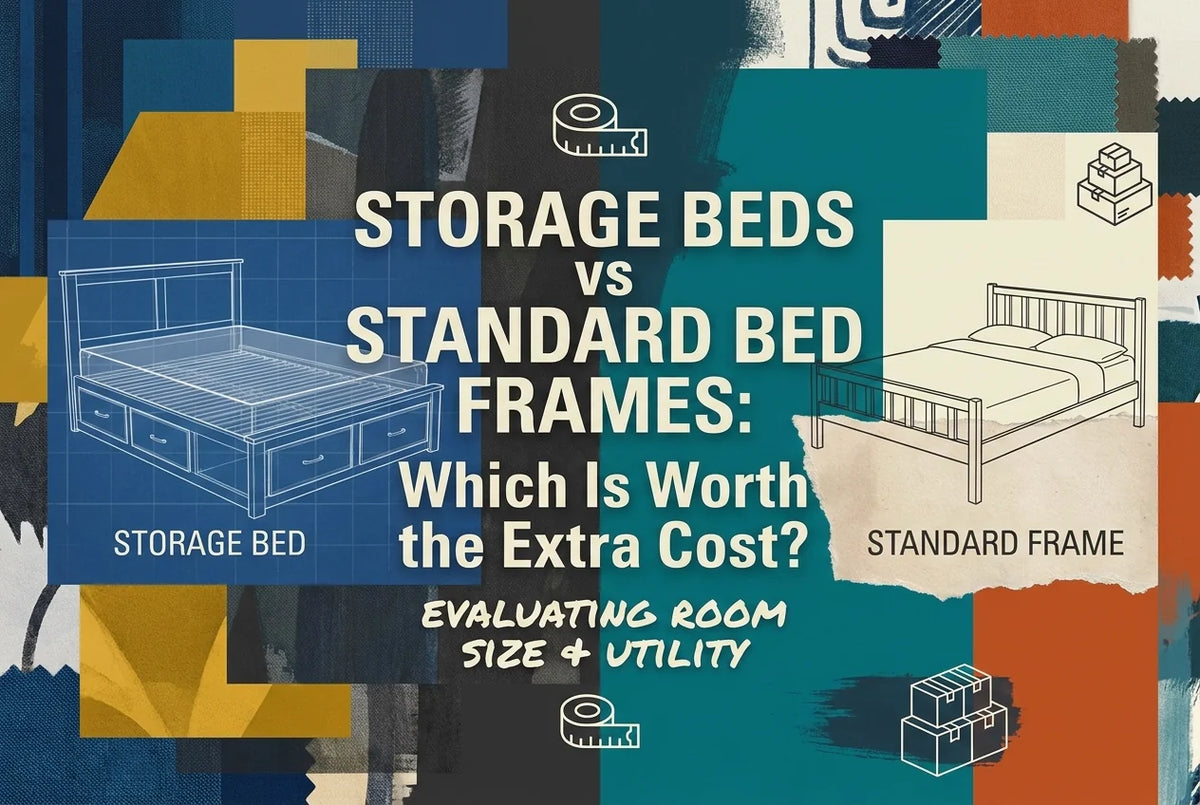
If you have ever stood in a furniture store staring at a storage bed with a price tag that made you wince, you are not alone. Storage beds cost noticeably more than standard bed frames australia shoppers are used to seeing, and that gap can feel hard to justify when you are already budgeting for a whole bedroom setup.
But here is the thing: for some bedrooms, that extra cost genuinely pays for itself. For others, it is money you could put toward something else entirely. The difference comes down to your room size, how you actually use your storage, and whether the built-in drawers or lift-up base will hold up over time.
This guide is designed to help you figure out which side of that line you fall on. We will walk through what you actually pay upfront, why room size matters more than most people realise, how different storage mechanisms compare, and what to check before you commit to buying. By the end, you will have a clear, practical answer for your specific bedroom situation.
The Real Question Is Not Features, It Is Value
Most articles about storage beds focus on features: how many drawers, what lift mechanism, how much clearance. That framing misses the more useful question, which is purely financial. Does paying more for a storage bed save you money on other bedroom furniture you would have bought anyway?
In smaller Australian bedrooms, particularly master bedrooms under 12m², a storage bed can do the job of a separate dresser or tallboy entirely. Those pieces carry their own purchase cost. If a storage bed replaces one, the upfront premium starts to look a lot more reasonable. If you are already thinking about how to furnish a bedroom without overspending, this trade-off is exactly the kind of calculation worth doing before you buy anything.
In short, the answer depends on your room size, your existing storage situation, and whether one higher upfront cost works better for you than several smaller purchases spread out. Each of these is explored in depth below.
What You Actually Pay Upfront
So let's put the costs on the table.
Standard bed frames vary considerably in price depending on size and material. Timber and solid wood bed frames sit toward the upper end of that range, reflecting both material costs and the durability that comes with them. A basic metal or engineered wood frame lands closer to the bottom.
Storage beds carry a meaningful premium over a comparable standard frame in the same size and material category. Double bed frames tend to sit mid-range across both types, making them a useful reference point when you are comparing the two side by side.
That upfront gap looks bigger in isolation than it actually is in context. A standalone tallboy or dresser adds its own purchase cost on top. If a storage bed replaces one of those pieces entirely, the real cost difference narrows considerably, sometimes to the point where the storage bed is the cheaper total outcome.
Worth noting at the budget end: cheaper storage beds are available, but the lowest-priced options often cut corners on drawer runner quality. That is not obvious in a showroom, but it becomes very obvious after 12 months of daily use.
Quality Rugs and Furniture stocks bedroom furniture across multiple price points, which means you can compare the combined cost of a storage bed against a standard frame plus separate storage pieces without bouncing between retailers. While you are there, it is also worth exploring their mattress range to budget the full bedroom setup in one go.
Room Size Is the Deciding Factor
Once you know what the premium actually looks like, the next question is whether your room justifies it, and here, square metres do most of the talking.
Under 12m² is where storage beds make the most obvious sense. Australian bedroom standards classify double bedrooms at a minimum of 11m², and at that size, fitting a bed and a full-height dresser or tallboy typically leaves you with awkward leftover space or blocked walkways. A storage bed replaces that separate piece entirely, which is a genuine net gain rather than just a feature add-on.
Between 12m² and 16m² is a grey zone. You can probably fit separate storage, but a storage bed still reduces visual clutter and frees up a wall for other furniture, better traffic flow, or simply more breathing room. It is not a necessity here, but it is rarely a bad call either.
Above 16m², the case weakens. A well-chosen tallboy or wardrobe tends to handle storage more flexibly at that size, and you have enough floor space to arrange them without the room feeling cramped.
This matters especially for urban buyers. Many apartments and newer townhouses feature bedrooms toward the smaller end of this range, which is precisely where the storage bed premium is easiest to justify.
Before committing either way, measure your floor plan and map out furniture to scale. A storage bed that replaces one piece of furniture is a space win. A storage bed squeezed into a room that still requires a separate wardrobe or dresser is just an expensive bed.
Storage Mechanisms Compared: Drawers vs Hydraulic Lift
Once you know your room can benefit from a storage bed, the next decision is which storage system will actually hold up for you.
Two mechanisms dominate the market: side-access drawers and ottoman-style hydraulic lift bases. They serve different needs and age differently, so the choice matters more than most buyers realise.
Drawer Systems
Drawers are a common starting point. They are simple to use, require no mechanical components beyond the runners, and if a drawer gets damaged, it can be repaired or replaced without touching the rest of the bed.
The weak point is runner quality. Metal full-extension runners are widely regarded as more durable than plastic channel runners. Plastic runners feel fine in a showroom but develop wobble and catching over time. When comparing options, this is the single most useful spec to ask about.
The practical limitation is size: drawers suit regularly accessed items like extra bed linen, but bulky pieces like a duvet or luggage simply do not fit.
Hydraulic Lift (Ottoman) Bases
An ottoman base lifts the entire platform to expose one large storage compartment beneath. That footprint handles the bulky seasonal items that drawers cannot: spare duvets, pillows, suitcases, and off-season clothing.
The trade-off is the gas struts. Struts can weaken with sustained use over time. When assessing one in-store, lift the base with the mattress on it and release. It should hold position cleanly; any slow drift downward signals early strut fatigue and is worth taking seriously.
The short version: drawers win on everyday convenience; an ottoman base wins on raw capacity for bulky seasonal storage.
Materials and Long-Term Durability
The mechanism you choose matters, but the material determines how long it holds up.
Storage beds take more structural punishment than standard frames. Every drawer cycle and every lift of an ottoman base puts repeated stress on joints, housing panels, and frame connections a standard base never experiences. Material choice is where that stress gets absorbed or starts to show.
Solid timber and timber bed frame constructions handle this load best. Solid wood resists joint flex over time and does not degrade the way sheet materials can under sustained mechanical use. If longevity is a priority, solid wood bed frames are worth the higher upfront cost.
Engineered wood (MDF and particleboard) is the default in budget storage beds and performs adequately for light, infrequent use. Problems emerge gradually: particleboard can be susceptible to moisture in poorly ventilated rooms, and drawer housing joints may weaken under heavy or repetitive loads over time. It is a trade-off worth understanding.
The single most useful question to ask is how the drawer boxes are joined. Dovetail or dowel joints are generally considered more durable than stapled construction. That detail is rarely listed on a product tag, so ask directly.
Upholstered storage beds in fabric or velvet work well when the visual effect is the priority and storage is secondary, but fabric surfaces attract dust and require regular vacuuming or spot cleaning.
On sustainability claims: phrases like "eco-friendly timber" or "natural materials" appear frequently in bedroom furniture marketing but are difficult to verify without third-party certification. For timber, look for FSC certification; for upholstery, ask about independent fibre-safety certification. When browsing the bedroom furniture range at Quality Rugs and Furniture, ask staff directly about material certifications before purchasing.
When a Standard Bed Frame Is the Smarter Buy
Material quality matters, but it only becomes relevant if a storage bed is actually the right tool for your situation. Sometimes it simply is not.
If your bedroom already has built-in wardrobes or a separate dresser that covers your storage needs, paying the storage bed premium solves a problem you do not have, and a well-made standard frame is the better value in that scenario.
Standard frames also win on design variety. Across every price point, you will find a broader range of solid wood bed frames, slimline timber bed frame profiles, and upholstered options in double bed frame sizing that simply do not exist in storage base versions. If the look of the frame matters as much as its function, a standard frame gives you more choices per dollar spent.
Renters and frequent movers deserve a specific mention here. Dismantling and reassembling a storage bed adds real complexity to a move. Ottoman lift bases are particularly awkward; moving one safely typically requires two people and enough time to avoid forcing the gas strut mechanism. If you shift house every year or two, that friction adds up.
For budget-constrained buyers, the calculation is especially clear. If the choice is between a cheap storage bed and a quality standard frame at a similar price, the standard frame is usually the better long-term investment. A structurally sound frame from a solid timber range will outlast a poorly constructed storage bed where corners have been cut on drawer runners or joinery. Paying for build quality in a simple frame beats paying for a storage feature in a frame that will not hold up.
What to Check Before You Buy: In-Store and Online
Once you have settled on a shortlist, do not skip the inspection step, whether you are shopping in-store or online.
In-store with drawer beds: open and close every drawer at least three times. You are looking for a smooth, even glide with no catching, wobbling, or racking at the sides. Rough operation on a showroom floor only gets worse once the bed is loaded at home. If it sticks now, walk away.
In-store with hydraulic lift bases: the same principle applies. Ask staff to place the display mattress on the platform and test the lift fully loaded. A well-built base holds position without drifting, and any slow descent is a signal worth acting on before you commit.
Shopping online: check that the product listing actually specifies drawer runner type (metal versus plastic), drawer box construction (solid timber versus MDF), and maximum load capacity for ottoman bases. Listings that leave these details out often have a reason for doing so. If the specs are not there, contact the retailer and ask directly before purchasing.
Warranty, both channels: confirm the warranty covers storage components specifically. A warranty that covers storage components including runners, drawer boxes, and gas struts, not just the frame structure, is worth confirming before you buy. Quality Rugs and Furniture's warranty and terms covers the complete bed, which gives you a useful benchmark when comparing other options.
One final measurement: check the clearance on each side of your bed before ordering. Many drawer systems require meaningful clear floor space on each side to extend fully, which can be a real problem in narrow rooms where the bed sits close to a wall.
Making the Call for Your Bedroom
Once you have worked through the inspection checklist, the decision usually comes down to three honest questions.
Is your bedroom under 12m²? If yes, and you lack adequate separate storage, a storage bed that replaces a tallboy or dresser you would have bought anyway is almost always worth the premium. You are not paying extra for a feature; you are consolidating two furniture costs into one.
Is your room larger, or is storage already covered? Then a standard bed frame is likely the stronger choice, offering more design variety and none of the mechanical complexity that comes with drawer systems or gas struts.
How does the storage mechanism hold up? Drawer runner quality and gas strut integrity are the components most worth scrutinising. If you could not assess these clearly through the steps in the previous section, that alone is a reason to keep looking before committing.
Run those three filters honestly: room size, total furniture cost including what the bed might replace, and storage mechanism quality. In most cases, the right answer becomes obvious quickly.
If you are still weighing options, Quality Rugs and Furniture, Melbourne's destination for bedroom furniture and more, carries both storage beds and standard frames across a range of price points, with stores in Dandenong South and Hoppers Crossing where you can compare both categories in person. You can also browse the full range and shop online today if visiting in store is not convenient.
Conclusion
Storage beds earn their premium when they replace furniture you would have bought regardless and use mechanisms built to last, while standard frames remain the stronger choice when storage is already covered and design flexibility matters more.
If you are ready to make a confident decision, Quality Rugs and Furniture offers both categories across multiple price points, with in-store experts in Dandenong South and Hoppers Crossing to help you find the right fit for your bedroom and your budget.